This month, we’re starting a new 3-part email series called “What is Performance Art?” I’ll be talking about some of the history of performance art, along with sharing several examples of works that shaped what we call “performance art” in the 21st century.
As we explore the complex and evocative realm of performance art, it’s important to understand the foundational characteristics that distinguish this form from more conventional art practices. Performance art is fundamentally ephemeral, predicated on the presence of the artist and the direct engagement with the audience. Performance art is intrinsically temporal, unfolding in real time, which often leaves behind no tangible artifact beyond the memory of the experience itself. It challenges the traditional “spectator” role, demanding active interpretation and emotional involvement from its audience, thereby dissolving the barriers between creator and observer, and between art and life.
Performance art also serves as a potent medium for critiquing societal norms, embodying personal or collective narratives, or simply exploring the materiality of the body and the dynamics of space and time. By its very nature, performance art resists commodification and remains fluid, often unpredictable in its outcomes and reception. This fluidity and immediacy make performance art a critical tool for artists seeking to confront pressing cultural and political issues, as it allows for a direct and visceral connection to the audience, fostering an immersive and reflective experience.
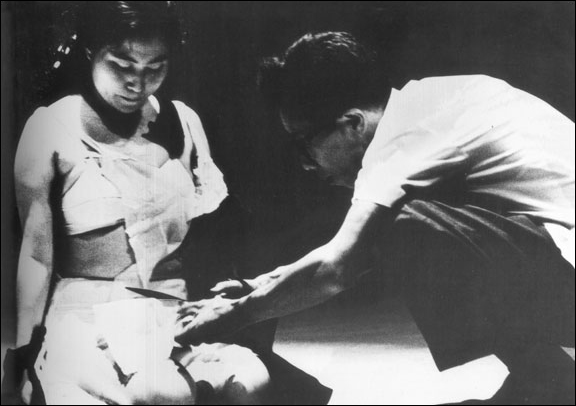
Yoko Ono’s performance pieces, such as “Cut Piece” (1964) and “Voice Piece for Soprano” (1961), exemplify the profound emotional and intellectual depth that performance art can convey. “Cut Piece,” performed repeatedly in various cities, invited audience members to cut pieces from Ono’s clothing while she sat silently, offering her body as both canvas and conduit for exploring themes of vulnerability, passivity, and the objectification inherent in female identity.
Conversely, “Voice Piece for Soprano” uses the primal act of screaming to articulate resistance against personal and societal oppression, thus transforming the voice into a powerful instrument of artistic expression and emotional release.
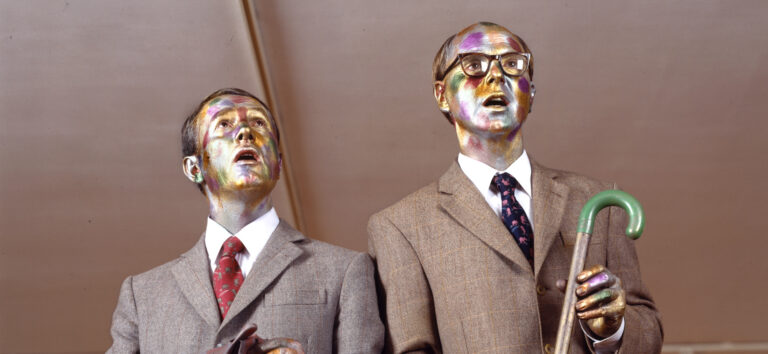
Gilbert & George have long transcended the traditional boundaries of sculpture to create what they describe as “living sculptures.” This transformation is exemplified in their seminal work, “The Singing Sculpture” (1969), where they use their own bodies as elements in a visually arresting tableau vivant, lip-syncing to a popular song while coated in metallic makeup. The suits they donned became their signature uniform, rarely seen in public without them.
Moreover, it is uncommon to see one without the other. They consider themselves “living sculptures,” refusing to separate their art from their daily existence, asserting that all their actions constitute art. This act of living as art interrogates the static nature of sculptural work, imbuing it with dynamism and a performative presence that challenges viewers’ perceptions of art and artist. In their “Jack Freak Pictures,” one of the most extensive series in their oeuvre, the duo further explores British identity and iconography, employing their bodies and symbol-laden imagery to critique and reflect on nationalism and belonging.
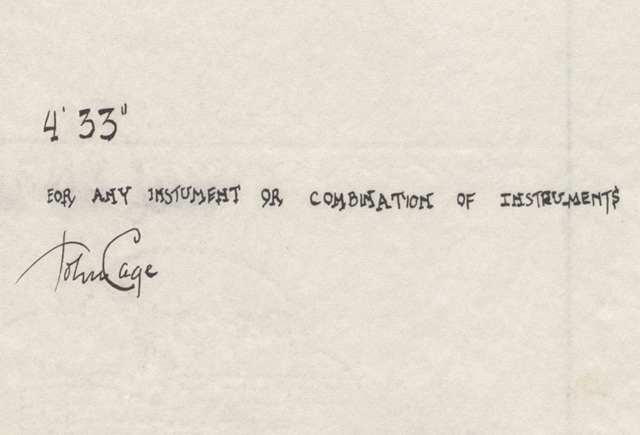
John Cage’s “4’33”” (1952) is a landmark exploration of live performance, challenging the very essence of music and composition. In this piece, the performer walks on stage carrying a stopwatch, takes his place at a lone piano, hits the timer, then opens the lid and sits in silence. After 4 minutes and 33 seconds, the performer closes the piano lid and concludes the piece without ever playing a single note.
The absence of deliberate sound production from the performer redirects the audience’s attention to ambient sounds, thus framing the “noise” of the environment as music itself. Cage’s conceptual piece not only redefined music but also acted as performance art by making the audience acutely aware of their own presence and the contingent nature of sound and silence. This piece provocatively questions the constructs of musicality and performance, encouraging a deeper awareness of the soundscape that constitutes our everyday lives.
In our next entry, “What Is Performance Art? Part 2” I’ll talk more about the possibilities of performance art, and take a look at three Asian performance artists and how their works shaped the history of art.